

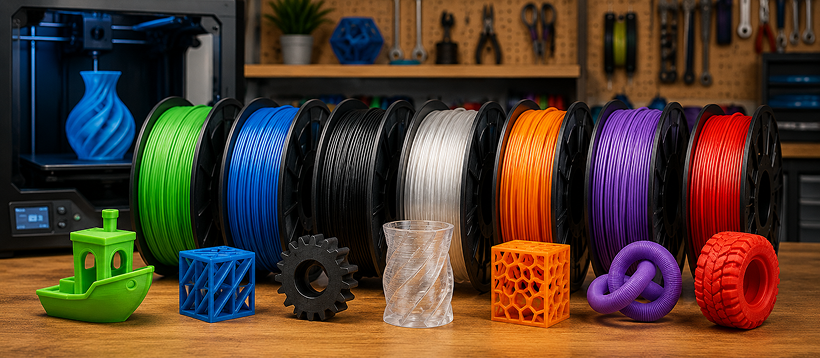
Picking the right 3D printing filament is the key to a successful print. The filament type affects how your print looks, how strong it is, and whether your printer can handle it at all. If you're still setting up your machine, it's worth browsing our range of 3D printer filaments to see what's available before committing to a type. This guide covers the four main types: PLA, ABS, PETG and TPU, and helps you choose the right one for your setup and your project.
What Is 3D Printing Filament?
Most desktop 3D printers use a process called FDM: Fused Deposition Modelling. Your printer feeds a thin plastic strand (the filament) through a heated nozzle. That nozzle melts the plastic and deposits it layer by layer to build up your object.
Filament comes on a spool, typically 1kg, and the most common diameter is 1.75mm. The material it's made from determines everything: print temperature, strength, flexibility, and how forgiving it is to work with.
The Four Main Filament Types
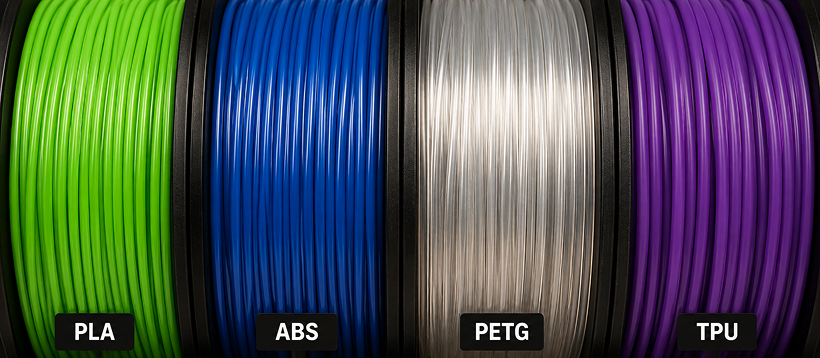
PLA: Best for Beginners & Display Models
PLA (Polylactic Acid) is the easiest filament to print with. It runs at a lower temperature (around 190–220°C), doesn't warp much, and doesn't need a heated enclosure.
It's made from plant starch, so it's more brittle than other materials and doesn't handle heat as well. Leaving a PLA print in a hot car could cause it to deform.
Use PLA for: models, prototypes, decorative prints, educational projects and anything that won't be exposed to heat or stress.
ABS: For Functional Parts That Need Strength
ABS (Acrylonitrile Butadiene Styrene) is stronger and more heat-resistant than PLA. It's the same plastic used in LEGO bricks and car parts.
The trade-off: it's harder to print. ABS prints at 220–250°C, needs a heated bed (around 100°C), and warps easily without an enclosure. It also releases fumes when melting, so good ventilation is essential.
Use ABS for: brackets, enclosures, mechanical parts, or anything going into a warm or high-stress environment.
PETG: The Middle Ground
PETG (Polyethylene Terephthalate Glycol) sits between PLA and ABS. It's tougher than PLA, easier to print than ABS, and more moisture-resistant than both.
It prints at around 230–250°C and needs a heated bed (70–85°C), but it doesn't require an enclosure. One thing to watch: PETG can string thin plastic threads between parts of your print if retraction isn't set correctly. Retraction controls how far the printer pulls filament back to stop oozing between moves, and it usually just needs a small adjustment in your slicer.
Use PETG for: outdoor parts, food-safe containers (with the right settings and nozzle), water-resistant prints, and everyday functional parts.
TPU: When You Need Flexibility
TPU (Thermoplastic Polyurethane) is a flexible, rubber-like filament. It is impact-resistant and can bend without breaking.
It's slower to print than other filament types and needs careful tuning. Printing too fast can cause the soft filament to fold back on itself in the feeder instead of moving forward. TPU is not ideal for beginners, but very useful for the right applications.
Use TPU for: phone cases, seals and gaskets, flexible clips and vibration-dampening mounts.
Shop 3D Printer FilamentsFilament Specs to Look Out For
Before you buy, check these filament specifications:
- Diameter: Most printers use 1.75mm. Some older or larger-format machines use 2.85mm. Check your printer's specs before ordering as this is a common frustration for makers.
- Print temperature: As listed on the spool. Your printer will need to reach this temperature. Budget printers often cap at 240°C, which rules out some engineering-grade filaments.
- Bed temperature: PLA can print on an unheated bed, while ABS and PETG need a heated bed. Be sure to check what your printer supports.
- Enclosure: ABS almost always needs an enclosure to prevent warping. PLA and PETG generally don't.
If you're not sure what printer you have or what it supports, take a look at our 3D printers and accessories range to check specs and compatibility.
Choosing by Project Type
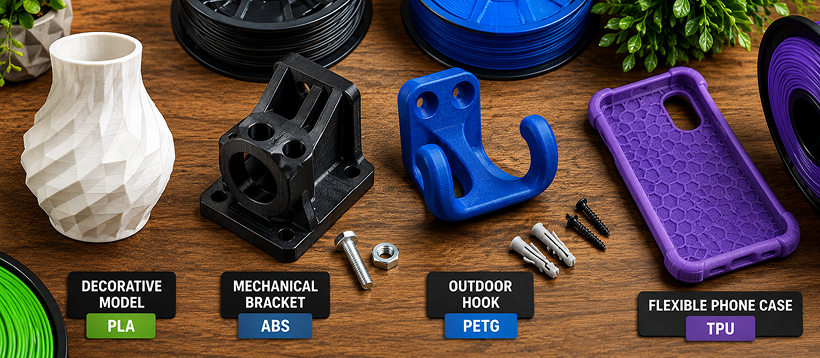
Display models and hobby prints: PLA is the right call for these. It's affordable, easy, and looks great. No need to spend more or deal with a harder material.
Functional parts including brackets, clips and housings: Opt for PETG or ABS. PETG is easier to work with, or choose ABS if the part needs to handle heat above 80°C.
Outdoor or moisture-exposed parts: PETG holds up better than PLA, which can degrade with prolonged UV and moisture exposure.
Flexible components: TPU is your only real option in this category. It takes more patience to print, but nothing else gives you that rubber-like result.
Not sure where to start with your first project? Our guide on getting started with 3D printing covers the basics of setup, slicing software, and first prints.
Common Mistakes to Avoid
- Leaving filament open to humidity. Moisture gets into the filament and causes popping, bubbling, and brittle layers. Store spools in sealed bags or a dry box with desiccant.
- Printing ABS without ventilation. ABS printing fumes are unpleasant and potentially harmful. Print in a ventilated space or use an enclosed printer with filtration.
- Buying the wrong diameter. Double-check your printer takes 1.75mm before ordering. 2.85mm won't feed through a standard 1.75mm system.
- Printing at the wrong temperature. Too low risks poor layer adhesion and clogs, while too high can cause stringing and oozing. Start in the middle of the manufacturer's recommended range.
- Ignoring bed adhesion. PLA sticks well to most surfaces. PETG can bond too strongly to bare glass, so try using a thin layer of glue stick or a PEI sheet. ABS benefits from a dedicated build surface or a thin layer of glue stick to help adhesion and prevent edge warping.
What to Buy Alongside Your Filament
A spool of filament is rarely all you need. Depending on your setup:
- Glue stick: Helps with bed adhesion for PETG and ABS, and makes it easier to remove PLA from glass beds.
- PEI build surface: Bonds well with most filaments when warm and releases the print cleanly once it cools. More reliable than bare glass for PETG and ABS.
- Dry box or airtight storage container: Essential if you live somewhere humid or don't print regularly.
- Spare nozzles: Brass nozzles wear over time, especially with abrasive filaments. Keep a few on hand.
- Enclosure: If you're printing ABS regularly, an enclosure reduces warping significantly.
Choosing Your First Filament
If you're new to 3D printing, start with PLA. It's the most forgiving, the cheapest, and the most widely available, allowing you to get comfortable with your printer before moving to anything more demanding.
When you're ready to print functional parts, try PETG. It's considerably tougher than PLA and far easier to work with than ABS.
Use ABS only when you need heat resistance above 80°C or superior rigidity, and only if your printer has a heated bed and you can print with proper ventilation.
TPU is a specialist choice. It's worth trying once you know your printer well and you have a specific need for flexible output.
Match the filament to the job, check your printer's specs before ordering, and store spools in a sealed container. That covers most of the common failure points before they happen. When you're ready to buy, Jaycar's full 3D printer filament range is the perfect place to compare options by material and weight.