

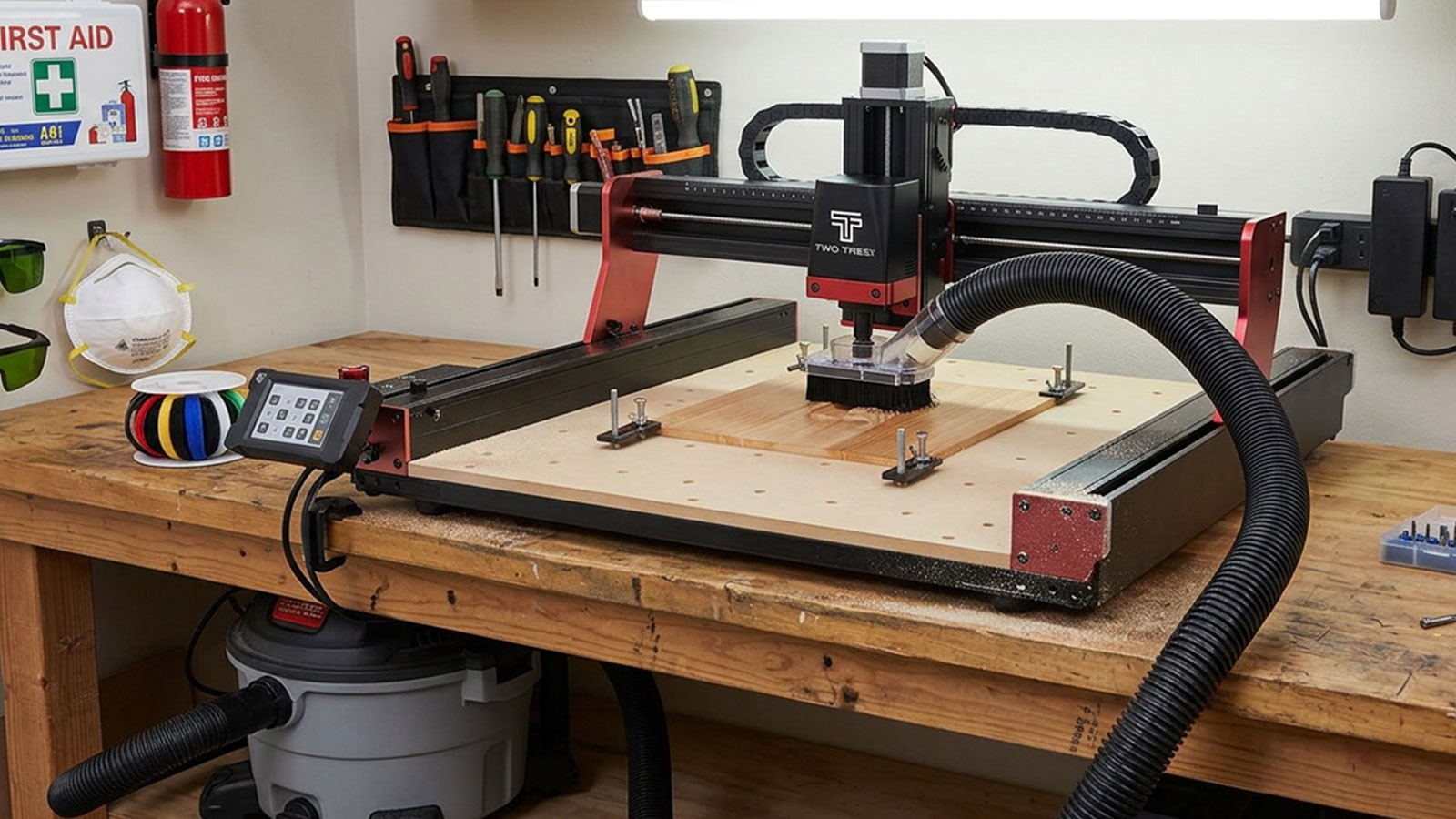
A home CNC workshop comes together around four things: a bench that won't move while you're cutting, a way to hold your workpiece in place, a way to manage dust and chips, and a bit of basic safety gear. Get those right and everything else, from picking bits to running your first job, gets a lot easier. This guide walks through each one, with real Jaycar Electronics accessories you can check against your own setup.
Building a Stable Bench
A CNC router only cuts as accurately as the surface it's sitting on. If the bench flexes or rocks while the spindle is moving, that movement transfers straight into the cut, showing up as chatter marks, uneven depth, or a rougher finish than the bit should be giving you.
- Solid, level surface — the bench top needs to sit flat with no rock, so the machine's own bed stays true.
- Enough load rating — factor in the router's weight plus your material and any add-ons like a vacuum unit sitting alongside it.
- Storage nearby — bits, spare parts and PPE are easier to keep track of when they live on the same bench as the machine.
Jaycar's self-assemble workbench (900 x 500 x 1400mm, CAT.NO HM8104) gives a 900 x 470mm work surface rated to 100kg, with a lower shelf, pegboard and a two-handled drawer underneath for bits and accessories. That's a comfortable fit for a benchtop machine like the Two Trees TTC450 Pro, with room to spare for clamps and offcuts.
Clamping & Hold-Down for Your Workpiece
Most benchtop CNC routers, including the TTC450 Pro, come with their own bed clamps for holding sheet stock down. Where a small bench vice earns its keep is everywhere else: holding a fixture steady while you set it up, gripping small offcuts for hand-finishing, or clamping a jig in place next to the machine.
- Mini Bench Vice (CAT.NO TH1764) — a lightweight aluminium vice for light-duty jobs, holding material up to 5cm thick with 63.5mm jaws.
- Vacuum Bench Vice With 75mm Jaw (CAT.NO TH1766) — a diecast vice with a vacuum base and 360-degree ball swivel, useful for small, fiddly parts that need repositioning mid-job.
Neither replaces the machine's own bed clamps for holding your main workpiece down, but both are handy for the setup and finishing work that happens around the actual cut.
Shop Workbench Gear & Safety GlassesFitting a Spoilboard
A spoilboard is a sacrificial layer that sits between your workpiece and the machine's actual bed. If a bit cuts a fraction too deep, or you're running a through-cut, it's the spoilboard that takes the damage instead of the bed underneath it.
The Two Trees Spoil Board (CAT.NO TL9002) is a direct-fit replacement for the TTC450 Pro (TL9000), giving you a fresh, flat surface once the original board has taken enough hits. Swapping it out is far cheaper than repairing a damaged bed, and it's worth checking the board for deep grooves every few projects rather than waiting until it fails.
Dust Extraction Options
Dust and chips build up fast on a CNC router, and left alone they cover the bed, clog the rails, and drift across the rest of the workshop. Beyond the mess, a layer of dust sitting over your workpiece makes it harder to see the cut line, and fine dust from MDF and some plastics isn't something you want to be breathing in regularly.
- Two Trees CNC Vacuum Upgrade (CAT.NO TL9001) — a dust extraction unit built for the TTC450 Pro, with a brushless motor, auto start-stop tied to the router, and a built-in LED light to see the cut area clearly.
- Replacement vacuum filters, 2pc (CAT.NO TL9004) — keeps suction consistent once the original filter starts clogging.
- Replacement vacuum bags, 2pc (CAT.NO TL9003) — swap in once the current bag is full rather than running the unit past capacity.
Running extraction from the first project, rather than waiting until dust becomes a problem, keeps the bed and rails cleaner for longer and cuts down on cleanup between jobs.
Shop CNC Dust ExtractionPPE for CNC Routing
CNC routing throws chips and dust up from the cut, so a small amount of PPE goes a long way toward making the workshop a safer place to spend time in.
- Eye protection — a pair of wrap-around clear safety glasses covers the basics: chips and dust flung up from the cut, especially when you're working close to the machine to check progress.
- Dust mask — a P2-rated disposable mask is worth keeping within reach for sanding, dusty materials like MDF, and clearing built-up chips by hand.
- Hearing protection — worth having on hand if you're running longer jobs or an upgraded spindle, particularly in a smaller room where the noise has nowhere to go.
None of this needs to be expensive. The point is having it within arm's reach so it actually gets used, rather than sitting in a drawer somewhere else in the house.
Managing Noise in a Home Workshop
A CNC router isn't silent, and an upgraded spindle, like Jaycar's 500W or 800W Two Trees upgrades, runs louder than the stock motor. Add a dust extraction unit running alongside it and a home workshop can get loud enough to notice from other rooms.
- Mount on a solid bench — a wobbly or hollow surface adds its own vibration noise on top of the spindle and extraction unit.
- Time your longer jobs — run lengthy cuts when they won't disturb the rest of the house, particularly in a shared space or apartment.
- Consider an enclosure — a simple box or partial enclosure around the machine reduces how much noise (and dust) escapes into the room.
Home CNC Workshop Checklist
Before running your first job, run through this list:
- Bench — solid, level, rated for the machine's weight plus material and accessories.
- Hold-down — bed clamps for your main workpiece, plus a bench vice for setup and small parts.
- Spoilboard — fitted and checked for deep grooves before each new project.
- Dust extraction — running from the first cut, with a spare filter and bag on hand.
- Eye protection — worn any time the machine is cutting.
- Dust mask — within reach for dusty materials and hand-clearing chips.
- Hearing protection — on hand for longer sessions or an upgraded spindle.
Frequently Asked Questions
Do I need a spoilboard for my home CNC router?
Yes, if your machine doesn't already have a sacrificial layer fitted. A spoilboard sits between your workpiece and the machine bed, so if a bit cuts slightly too deep, it damages the spoilboard rather than the router's bed. The Two Trees Spoil Board is a direct-fit replacement for the TTC450 Pro's bed once the original wears out.
What size workbench do I need for a home CNC router?
Enough surface area to secure the machine with room around it for clamps and material, plus enough weight or anchoring to stay still while cutting. Jaycar's self-assemble workbench gives a 900 x 470mm surface rated to 100kg, which comfortably suits a benchtop CNC router like the TTC450 Pro.
How do I stop dust and chips getting everywhere?
Pair a dedicated dust extraction unit, like the Two Trees CNC Vacuum Upgrade, with your router so chips are captured at the cutting head rather than spread across the workshop. Keep spare filters and bags on hand so suction doesn't drop off between cleans.
Can I run a CNC router without dedicated dust extraction?
You can, but it isn't recommended for regular use. Without extraction, dust builds up on the bed and rails, cutting visibility drops, and fine dust spreads through the room, which is worse for materials like MDF and for your lungs. A basic mask helps in the short term, but proper extraction is the better long-term fix.
What safety gear do I actually need for CNC routing at home?
At minimum, wear eye protection like a pair of wrap-around safety glasses, since chips and dust can fling up from the cut. A P2-rated dust mask is worth keeping nearby for sanding and dusty jobs, and hearing protection is a good idea if you're running the router for extended sessions.
How do I reduce CNC router noise in a home workshop?
Mount the machine on a stable, heavy bench rather than a hollow or wobbly surface, since vibration adds to the noise. A dust extraction unit running alongside the spindle will also add its own noise, so consider running longer jobs at times that won't disturb others in the house.
A stable bench, reliable hold-down, a fresh spoilboard, dust extraction from day one, and a little PPE cover the basics of a home CNC workshop. Start with those, and the rest, choosing bits, learning the software, picking your first project, is a lot more straightforward.