

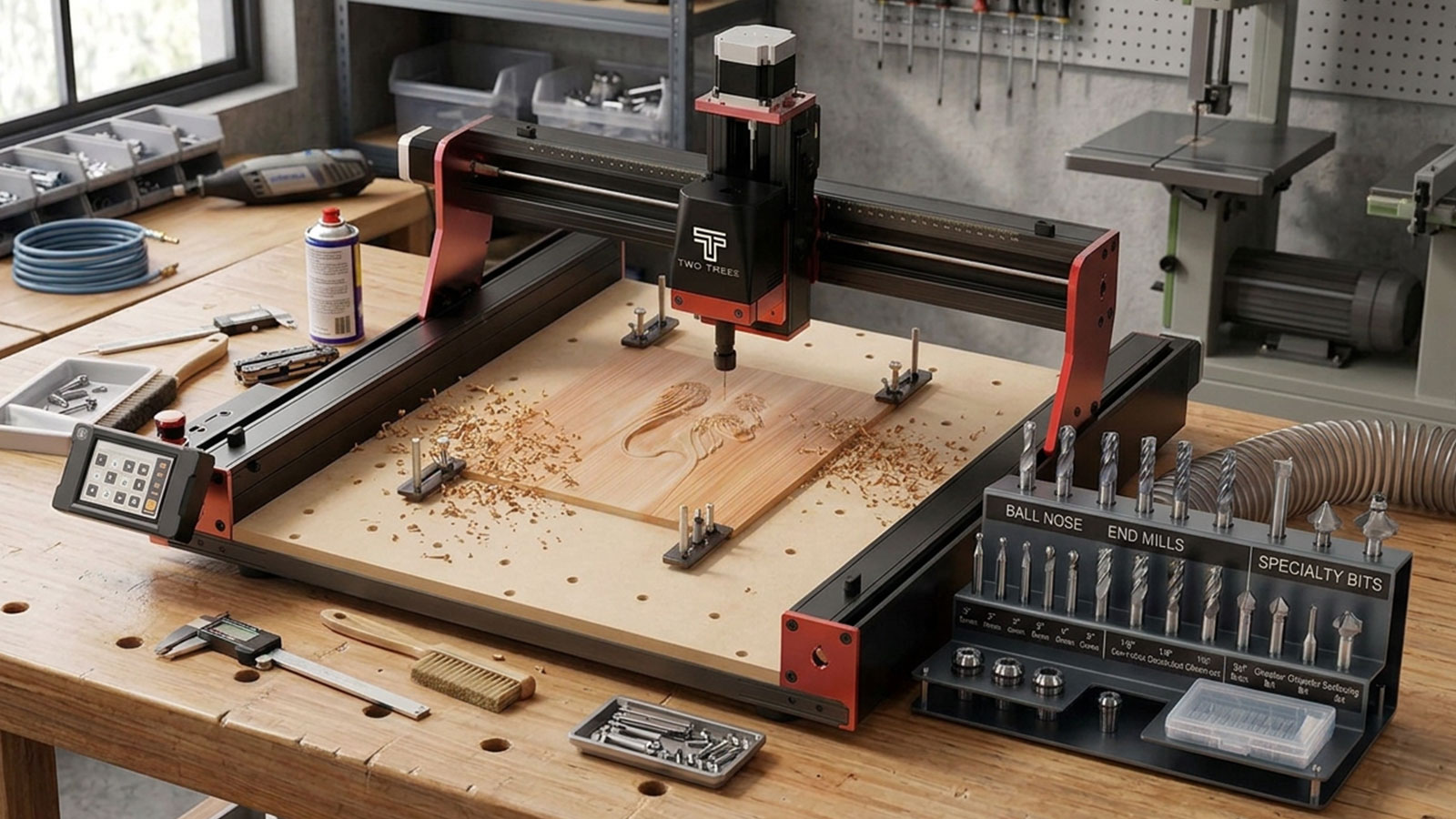
Getting CNC router bits explained doesn't need to be complicated: the bit's tip shape decides the finish you get, and its flute design decides how fast and how cleanly it cuts. This guide walks through the main bit types, straight, spiral, ball end and taper, how to match a bit to your material, when it's time to retire a worn one, and the confirmed bits in Jaycar's CNC router range so you know exactly what to buy next.
Bit Types Explained
Every CNC router bit falls into one of a few core shapes, and the shape determines what kind of cut and finish you'll get.
Straight Bits
A straight bit cuts a flat-bottomed groove or slot with vertical sides. It's the simplest shape and a good default for slotting, mortising and basic cut-outs where you don't need a decorative edge.
Spiral Bits
A spiral bit winds its cutting edge around the shaft like a drill bit, pulling chips up and out of the cut as it goes. This clears waste more efficiently than a straight bit, which means less heat build-up, less clogging and a cleaner finish, particularly on deeper cuts.
Ball End Bits
A ball end bit has a rounded tip instead of a flat one. It's built for contoured, 3D shapes and detailed carving, where a flat-bottomed bit would leave visible ridges.
Taper Bits
A taper bit narrows along its length instead of running a constant diameter. It suits detailed carving and tapered profile work, such as sloped edges or fine lettering, where the taper follows the profile of the design.
Matching Bits to Material
The right bit shape still needs to suit the material you're cutting.
- Wood & MDF — spiral and straight bits handle general milling well, while a compression-style bit reduces splintering on fine detail work.
- Plastics & acrylic — a spiral bit clears chips efficiently and reduces the risk of melting from heat build-up.
- Soft metals — use a bit specifically built for metal, run it at a slower feed speed, and expect shorter bit life than wood or plastic work.
- Detailed carving & 3D contours — ball end and taper ball end bits follow curved surfaces that a flat-bottomed bit can't.
If you're not sure which material a bit suits, check the product listing before you buy. Running the wrong bit in the wrong material is one of the fastest ways to snap it.
When to Replace a Bit
A bit doesn't need to look damaged to be worn out.
- Burn marks or a rough finish — often the first sign a bit has gone dull, even if the edges still look sharp.
- Increased chatter or vibration — a dull bit works harder to cut, which shows up as vibration rather than a clean pass.
- Visible chips or a bent tip — replace immediately rather than continuing to run a damaged bit.
- A jump in required feed pressure — if you find yourself slowing the feed rate further and further to get the same result, the bit is on its way out.
Jaycar CNC Router Bit Range
Every bit below is a confirmed part of Jaycar's CNC router bit range, sized for the Two Trees TTC450 Pro's 3.175mm shank.
- CNC Double Edge Straight Grove Mill Cutter (CAT.NO TL9015) — Straight bit. Suits straight groove and slotting work.
- CNC Double Edge Spiral Mill Cutter 3.175mm (CAT.NO TL9006) — Spiral bit. Suits general wood & plastic milling.
- CNC Double Edge Spiral Mill Cutter 45mm (CAT.NO TL9013) — Long-reach spiral bit. Same general wood & plastic milling, with extra reach for deeper cuts.
- CNC Double Edge Ball End Mill 3.175mm (CAT.NO TL9005) — Ball end bit. Suits detailed carving and contour work.
- CNC Double Edge Spiral Ball 3.175mm (CAT.NO TL9012) — Spiral ball end bit. Suits detailed carving and 3D contour work.
- CNC 2 Flute Taper Ball End Mill (CAT.NO TL9010) — Taper ball end bit. Suits detailed carving and tapered profile work.
- 3.175mm CNC Single Spiral Point (CAT.NO TL9011) — Single-flute spiral bit. Suits fine detail and point-cutting work.
- CNC Tripple Edged Set 3.175mm, 10pc (CAT.NO TL9009) — Triple-edge bit set. Covers a range of general milling jobs.
- CNC Corn Milling Cutter 0.8-3.175mm Titanium, 10pc (CAT.NO TL9007) — Titanium-coated, compression-style bit set. Suits detailed engraving and fine milling work.
- CNC Metal Milling Cutter 3.175mm, 3pc (CAT.NO TL9008) — Metal-cutting bit set. Built for cutting metal stock cleanly.
- CNC Rotary Cutter 6mm (CAT.NO TL9014) — Larger rotary cutter. Suits general-purpose routing and edge work.
Frequently Asked Questions
What size shank do Jaycar's CNC router bits use?
Every bit in the range uses a 3.175mm (1/8") shank, matching the Two Trees TTC450 Pro CNC router. You don't need an adaptor or collet change to swap between bits in the range.
What's the difference between a spiral bit and a straight bit?
A straight bit cuts a flat-bottomed slot but doesn't clear chips as efficiently. A spiral bit winds around the shaft to pull waste up and out of the cut, giving a cleaner result and less heat build-up, particularly on deeper passes.
Can I use a wood bit to cut soft metal?
No. Metal needs a bit specifically built for the job, like Jaycar's CNC Metal Milling Cutter, run at a slower feed speed. Using a wood or plastic bit on metal will dull or snap it quickly.
How do I know when to replace a CNC router bit?
Watch for burn marks, a rough finish, increased vibration, or a bit that needs a slower feed rate than usual to get the same result. Any of these point to a bit that's past its best and should be swapped out.
Do I need a ball end bit for every project?
No. Ball end bits are built for contoured, 3D carving work. For flat cut-outs, slots or general milling, a straight or spiral bit does the job and lasts just as long.
Are these bits only compatible with the Two Trees TTC450 Pro?
They're sized and sold as spares for the Two Trees TTC450 Pro, which uses a standard 3.175mm shank. They may also fit other CNC routers that take the same shank size, but check your machine's collet size before buying.
Choosing the right CNC router bit comes down to matching the shape to the job: straight for slots, spiral for general milling, ball end for contours, and taper for detailed profile work. Keep an eye on finish quality and vibration to know when a bit needs replacing, and you'll get consistent results from Jaycar's confirmed bit range.